The F-Word
How Millennials and Gen Z Gave Profanity the Seal of Approval

Warning: This article contains spicy curse words. If you are easily offended or under the age of 18, please skip this essay.
Let’s face it. Millennials and Gen Z have done something artists have tried for centuries to do—they have given the word “fuck” the full seal of approval as a word to be spouted anytime, anywhere, by anyone.
Turn on a podcast—any podcast—and there it is. I started listening to the New Heights podcast when my girl, Taylor Swift, began dating Travis Kelce. And I admit, the show is good, especially as it’s moved from strictly sports to a more mainstream podcast.
The Kelce brothers, America’s favorite football family, drop the F-bomb on New Heights so casually that Common Sense Media had to warn parents about the “frequent use of the ‘F’ word and other cuss words in a playful, casual manner” (Common Sense Media).
Jason Kelce’s wife, Kylie? She launched her own podcast, Not Gonna Lie, with a tagline that reads “armed with one mic and zero f*cks” (Apple Podcast). A couple of weeks ago, when somebody complained about her (and Travis Kelce, except the person called him Trevor) constant swearing, she fired back: “Who the fuk is Trevor? If you mean Travis, my brother-in-law, you’re fu**ng right” (Total Pro Sports). She’s defended it by saying the word just “adds to my vocabulary and emphasizes my point” (Yardbarker).
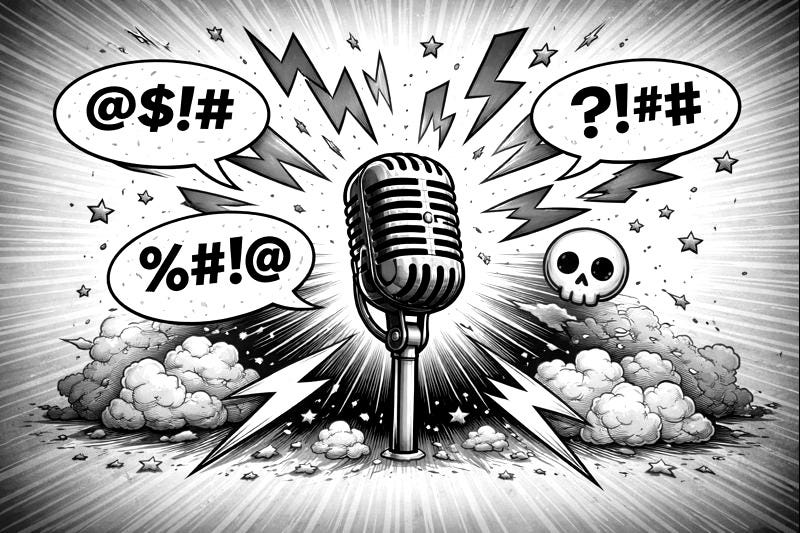
That’s the thing now. The F-word isn’t profanity anymore. It’s punctuation. Millennials and Gen Z use it the way Baby Boomers said “um” when they couldn’t think of the next word, or the way Gen X said “like” every third syllable. It’s become a verbal filler. A placeholder. A comma with teeth.
The shift’s everywhere you look. Pop stars who used to be wholesome are throwing it into lyrics without a second thought. Streaming shows drop it a dozen times an episode. Even our sitting president got caught on camera at a Ford plant in Michigan recently, appearing to mouth “f**k you” twice and flipping off a worker who’d yelled at him. The White House called Trump’s response “appropriate” (Washington Post). This wasn’t his first time using the word on TV. He’s dropped it on several occasions during press conferences.
That’s where we are now. The president can say the F-word and give somebody the finger on national television, and his press secretary shrugs it off.
Of course, flipping the bird isn’t exactly new, even for the wholesome crowd. There’s a famous photograph of Johnny Cash—the Man in Black himself, a gospel singer, and a Christian icon—giving the camera the middle finger. The photo was taken in 1969 at San Quentin State Prison during Cash’s legendary live performance there. Photographer Jim Marshall asked Cash to “take a shot for the warden,” and Johnny decided that flipping the bird was the most appropriate gesture to make (Wide Open Country).
The photo stayed relatively obscure for decades. But in 1998, after Cash won a Grammy for Best Country Album with Unchained, he couldn’t get country radio to play his music. Nashville had decided he was too old, too rough, too out of step with the slick, polished sound they were pushing. So his producer, Rick Rubin, took out a full-page ad in Billboard. The ad featured Cash’s middle finger photo with the caption: “American Recordings and Johnny Cash would like to acknowledge the Nashville music establishment and country radio for your support” (Saving Country Music).
But here’s the thing: Cash wasn’t vulgar for the sake of it. In “A Boy Named Sue,” recorded live at San Quentin, Cash quotes the ne’er-do-well father saying, “I’m the son of a bitch that named you Sue”—but the album version bleeped it out. Even the Man in Black knew there were lines. He pushed them, sure. But he knew they existed (Saving Country Music).
That’s the difference. Cash’s middle finger meant something. It was pointed at power, at hypocrisy, at a system that claimed to care about decency while ignoring the prisoners he sang for. It had weight.
Today’s F-word? It’s just filler. It doesn’t mean anything. It’s no more than a verbal tic, a placeholder, a way to fill dead air while your brain catches up to your mouth. The word’s been stripped of its power by overuse. It’s not rebellion. It’s not transgression. It’s just... there.
I’ll admit that I, too, have fallen into the trap of using the F-word on occasion when I’m really mad. But not as a filler word. There’s a difference between dropping an F-bomb when you’ve slammed your thumb in a car door and sprinkling it into every sentence like seasoning salt.
Ironically, all of this is enough to make the late genius comedian George Carlin roll over in his grave—or maybe laugh his ass off.
In 1972, George Carlin took the stage in Santa Monica, California, and delivered a monologue that would become legendary: “Seven Words You Can Never Say on Television.” You can look up the words in the sourcing here (Wikipedia). Or you can hear them on just about any television show. Carlin’s bit was sharp, funny, and a pointed takedown of the absurdity of singling out seven words from the roughly 400,000 in the English language as capable of corrupting our souls just by speaking them aloud.
He wasn’t the first comic to fight this battle. Lenny Bruce had been waging war against obscenity laws since the 1950s. Bruce’s act was raw and filled with profanity, sex, religion, politics—all the things you weren’t supposed to talk about in polite company. He got arrested for it. Over and over. San Francisco in 1961. Los Angeles in 1962. Chicago in 1963. His most famous arrest came in 1964 at the Cafe Au Go Go in Greenwich Village, where he was convicted of obscenity (Free Speech Center). The trial destroyed his career. Venues wouldn’t book him. He died broke in 1966 at forty years old, before his appeal could be heard. New York didn’t pardon him until 2003—the first posthumous pardon in the state’s history (New York Times).
Carlin had been with Bruce in Chicago when his mentor was arrested for saying at least two of the forbidden words during a show (Biography). He watched what happened to Bruce—the arrests, the trials, the career implosion. When Carlin took the stage in 1972 with his “Seven Words” routine, he knew exactly what he was risking. He was picking up the fight Bruce had started.
And Carlin got arrested, too. In Milwaukee, a few months after debuting the routine, he performed it at Summerfest and was hauled off for disturbing the peace. The charges got tossed, but the real fight was just starting. A radio station, WBAI in New York, broadcast a version of the routine in 1973, and a man named John Douglas—listening with his fifteen-year-old son—filed a complaint with the FCC. That complaint turned into FCC v. Pacifica Foundation, a Supreme Court case that’s still taught in law schools today. The Court ruled the FCC had the right to regulate “indecent” speech on public airwaves (Justia).
Fifty-three years later, those same seven words are still technically banned from broadcast television during daytime hours. The FCC prohibits obscene content at all times and indecent or profane content between 6 a.m. and 10 p.m. (FCC). But here’s the joke: those rules don’t apply to cable, satellite TV, or satellite radio because they’re subscription services (FCC).
You can say the F-word all you want on HBO. Netflix? Go wild. YouTube? Nobody’s counting.
And here’s where it gets really absurd. While the FCC polices Carlin’s seven words—words about sex and bodily functions—there’s one word that slides right through: the ‘GD’ word, otherwise known as goddamn. I heard it often enough growing up, spewing from my parents’ mouths, but I knew early on that I better not say it.
According to the FCC, using “god damn it” is not “legally profane” (NPR). But tell that to Christians. For many believers, it is the worst word you can say. It violates the Second Commandment directly by taking the Lord’s name in vain.
Recently, a Christian group called One Million Moms launched a petition against NBC for airing a contestant on Deal or No Deal Island who repeatedly took God’s name in vain while the network bleeped out other curse words (Christian Post). The petition got over 13,500 signatures. Networks will bleep sh*t and f**k during the day, but ‘GD’? That one gets through.
But broadcast TV’s quaint little rules are irrelevant now anyway. The real action’s on streaming, and streaming doesn’t have a censor.
It’s nearly impossible to find a show on Netflix that not only uses these words but also shows the F-word in action. Sex scenes so explicit they’d make a 1970s porno blush. And kids are watching these shows in their rooms on their devices. No parent is standing over their shoulder. No network standards department wringing its hands. Just a fifteen-year-old (or younger) with an iPhone and a Netflix password.
This came up because I was talking with friends about the show. Four of us at the table, and I was the only one who’d watched the entire series—alone, blinds closed, hands half over my face, peeking through laced fingers with one cautious eye.
Last summer, a show based on a hit book by Texas author May Cobb—The Hunting Wives—was packed with sex. Not implied sex. Explicit, lingering scenes that would’ve shut down a network broadcast in about thirty seconds.
What struck me wasn’t the content itself, but the reaction—or lack of one. Millennials and Gen X talked about it the way people talk about weather. “Did you see episode three?” tossed off in passing, with the same flat inflection you’d use to ask if someone caught the latest episode of Young Sheldon.
No shock. No embarrassment. Just casual, public conversation. The sex wasn’t transgressive to them. It was background noise.
Ironically, at the same time The Hunting Wives was the number one streaming show on Netflix, clean comic Leanne Morgan had a new sitcom, simply called Leanne, that was number two in the Netflix ratings. And Nate Bargatze, another clean comic, has taken the nation by storm with his clean, wholesome act, selling out arenas across the country.
Clearly, there’s a niche that wants the clean version.
Research from Rivers State University published in 2025 and circulated via ResearchGate found that Generation Z uses swear words more often and with a more positive attitude, incorporating them into everyday conversations—both face-to-face and on social media—to a greater extent than older generations (ResearchGate). A San Diego State University study analyzed tens of thousands of books and found that curse words were used in literature 28 times more often in the mid-2000s than in the early 1950s (NBC San Diego).
The shift isn’t subtle. It’s seismic.
During the 1960s and 70s, the sexual revolution dragged the F-word into mainstream use. Carlin’s “Seven Words” routine in 1972 was both a reflection of and a catalyst for that shift.
The word has gone from unprintable to unavoidable in the span of a few decades.
And now?
Here’s the thing. The genie is out of the bottle. The F-word is here to stay. The president uses it. Congress uses it. The Kelces use it. Taylor Swift uses it.
It’s everywhere.
Maybe the real obscenity isn’t the word itself. Maybe it’s the pretending. The idea that we can police language while the culture’s already moved on. The notion that a word broadcast at 2 p.m. is dangerous, but the same word on a podcast downloaded by millions of teenagers is just entertainment.
Carlin would’ve had a field day with this. Hell, he’d probably add a few more words to the list just to watch us tie ourselves in knots trying to explain why some are okay and others aren’t.
So can we all agree now that it’s a perfectly fine word to say, or are we going to continue to clutch our pearls?
Pick one.
I need to know what I can say when neighbors visit.
—Carol
Words have power "Four score and seven years ago ..." Yet when those words become an everyday occurrence they lose that power and become just words again. Whether profane or blasphemy. The shock value and power diminishes. We have seen it recently when some persons celebrated the death of a person in Utah. I am guilty of using swear words with increasing frequency as I grow older. I seldom used them in my youth (except for my service in the Army.) Because I knew my elders would not look kindly on such language. I often admonish myself for choosing from such a limited vocabulary when there are so many better choices available. Yet in that minute pause between thoughts and spoken words I do lapse to the easy choice.
Fu**ing GREAT PIECE! (Big Smile)
I try not to, but I've used it a few times in anger. Very interesting that it no longer has the shock value that it used to. Great piece!