The Memory That Raised Me
Dallas, 1963: a classroom lost a child, a block lost its policeman, and the country lost its President

My first memory isn’t mine at all. It’s borrowed from my sister Annie’s eyes, my brother Bubba’s ears, and my mother’s retelling until it rooted in me as if I’d lived it myself.
Annie sat at her desk on a bright Dallas morning, staring through the tall window. Two policemen crossed the schoolyard. A minute later, they filled the doorway of the classroom. The teacher’s hand shook. She brushed the chalk dust across her skirt. A white streak clung to the wool.
The room grew still. The officers leaned close, their voices too low for the children to hear. The teacher’s eyes watered; she nodded toward Brenda Tippit. The policemen gathered her, books and sweater in hand, and led her out. The classroom could feel the weight of what was coming.
By the end of the day, Brenda’s father—our neighborhood hero—was gone, the President too, and history left its shadow across Oak Cliff.
The night before, the kids were still playing outside. Somewhere, a football thudded against a knee, and somebody’s mama hollered for them to watch for cars. Garage doors stood open, light spilling onto driveways. Men were bent over engines, grease on their knuckles, beer cans sat nearby.
Officer J.D. Tippit was out there too, two doors down, probably under a hood or tossing a ball with his boys. Nobody knew yet that by the next afternoon, he’d be the first officer to confront the man who killed the President.
Mama was up the street with the neighbor women, chattering about what they thought Jackie would wear when she visited Dallas the next day. Most of the families on Meadowshire were Catholic or something near it. Mama’s claim to the church came through the orphanage that raised her. The kind of place that took you in when your family couldn’t—or wouldn’t—keep you.
We had five kids under our small roof. Charlie and Annie were ten-year-old twins. Bubba was eight, chasing their shadows. Doodle Bug at four-and-a-half was always loose and wild. And me—not quite a year old—watching from a high chair or Mama’s arms.
By morning, the fog had burned off, leaving the streets damp and slick in the seams the sun hadn’t yet touched. Mama had all five of us moving—Charlie and Bubba in their rolled jeans at the cuffs and high top P.F. Flyers shoes from Kinney’s Shoe Store, where kids clattered around in metal foot sizers while their mothers gossiped near the register. Annie twirled in her hand-sewn pinafore dress and saddle oxford. Doodle Bug hung on to somebody’s skirt hem, while I balanced on a hip as Mama handed out brown lunch sacks.
Charlie, Annie, Bubba, and Brenda Tippit usually met up with other neighborhood kids at the corner. Back then, they always traveled in a pack, like a small parade making its way toward Umphrey Lee Elementary.
In Annie’s retelling of that horrible day, the intercom is absent—she doesn’t remember the principal’s voice, the crackle, the gasp that must have swept the room at the announcement. She remembers only the policemen at the door, the teacher’s tears, Brenda’s empty chair. That was the loss that marked her. And within days, the Tippits themselves were gone, moved across town almost overnight.
Bubba was in third grade, in choir, when the message reached them. The intercom cut off the piano. The children’s voices slowed, then stopped. The principal cleared his throat, then stated in a shaky voice: The President is dead.
The gasp, the silence bearing down on the children’s chests. His memory has always felt strange beside Annie’s, like they lived two different days. Where Annie carried the trauma of a friend taken from her, Bubba carried the trauma of a nation whose president was taken too young.
Two children, two gasps, two kinds of grief.
Mama later said the street itself went slack. Men stood in driveways with radios pressed to their ears listening to KLIF. Women covered their mouths. Some neighbors crowded together in silence.
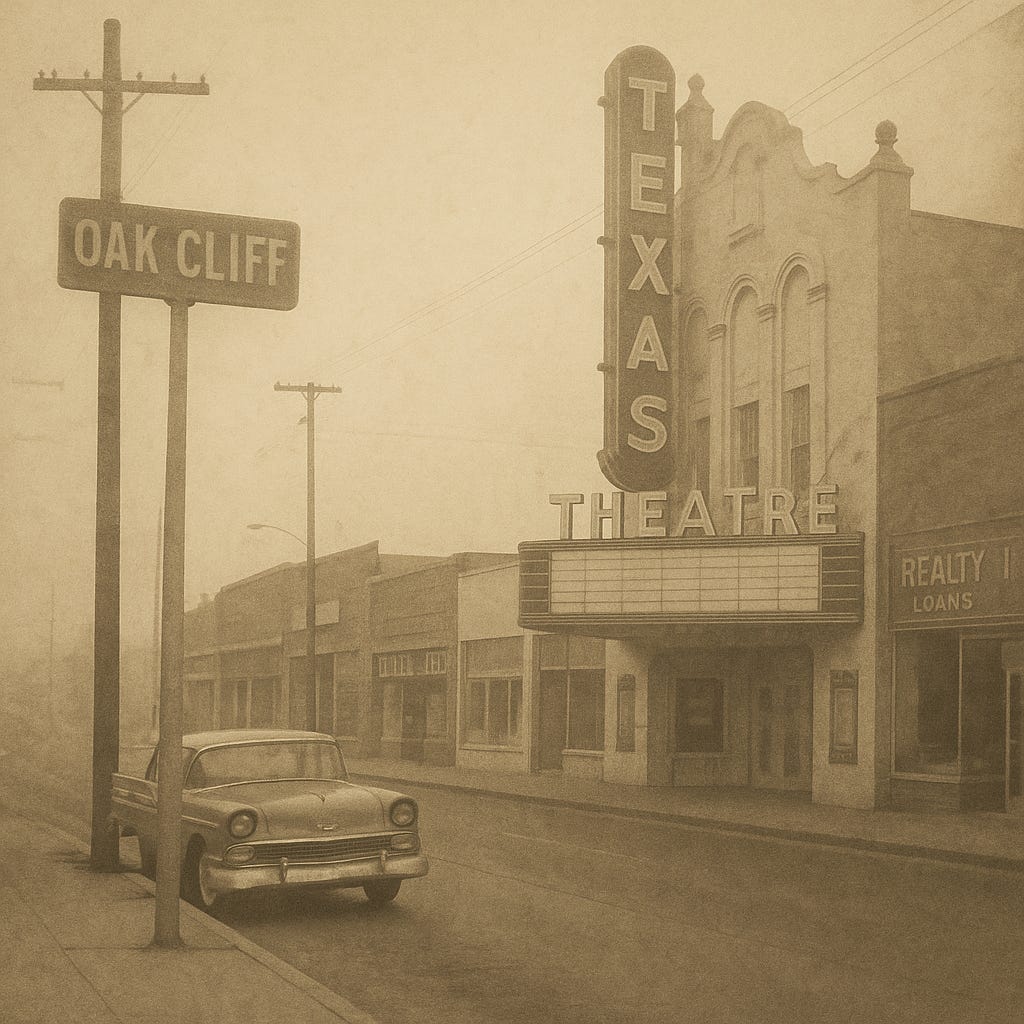
They walked home without Brenda that day. And they never again saw their big, laughing police friend in the street. Officer Tippit–husband, father, neighbor–was shot dead in Oak Cliff by the man who had just killed the President. They pulled Oswald from the Texas Theater, the same theater where neighborhood children once lined up with nickels for popcorn and lost themselves in Saturday cartoon reels.
We didn’t just lose a policeman that day. We lost the Tippits too—Brenda gone from the classroom, her mother gone from the house, their laughter gone from the block. Only Allan remained close by, long enough to tie himself to our cousin at Kimball High, a friendship that lasted until his own passing. The neighborhood was never quite the same. The absence of that family cast another shadow across Oak Cliff. History did not just stain the headlines; it bled into Brenda’s empty chair, into the silence where Tippit never came home, into the small, ordinary lives that never made the news.
Memories fade over the years. Annie doesn’t tell that story much anymore. When she does, the edges are worn smooth. But for me, it was the first memory ever pressed into me—one I never lived, but one that claimed me all the same.
About this post:
This memory—borrowed but carried—is one of the cracks that shaped the world I grew up in. Psalm of Lies, my novel-in-progress, digs deeper into the Oak Cliff threads that tied our little street to the biggest crime in Dallas history: my father’s nights at Jack Ruby’s Carousel Club, his claim that he saw Lee Harvey Oswald there just days before the assassination, and the shadows our family lived with afterward.
—Carol
© 2025 Carol Countryman. All rights reserved.
This piece is part of Psalm of Lies and the ongoing series Tales from East Texas.
Please share the link, not the text. Reprints, excerpts, or readings by permission only: carolcountryman@gmail.com.
Wow sis, I wish I had your talent. I love reading what you write something that I was never good at maybe because I did not enjoy doing it, but there is not a home out there. I can’t build we all have our own path in life. I hope you keep following yours. I am so proud of you. !
Carol, as always a great story only this time this one really resonates with my memories of that day as if it was yesterday after 63 years and we still don't know what really happened! Congratulations! Kudos!