UPDATE: Liam Ramos Released
But what about the children nobody photographed

Saturday morning, I published a piece about five-year-old Liam Ramos. By Saturday evening, a federal judge ordered him released.
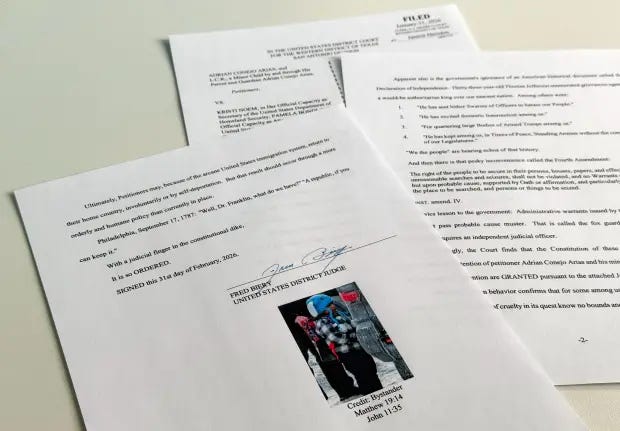
U.S. District Judge Fred Biery didn’t hedge. The government, he wrote, was pursuing deportation quotas “apparently even if it requires traumatizing children.” He invoked the Constitution. He said get that child out of Dilley.
Liam walked out of the South Texas Family Residential Center because a judge decided his prolonged detention violated constitutional norms and because a photograph of a frightened boy in a Spider-Man backpack forced people to look.

I want to believe that’s how it works. I want to believe visibility equals accountability. That if enough people see a thing, the thing stops happening.
Two more children from Liam’s elementary school—a second grader and a fifth grader—were taken into custody last Thursday. Their mother was detained during a routine court appointment. She had no family in Minnesota who could take her sons. So she called the school. She asked the principal to bring her children to her.
The principal had to tell two boys they were going to a detention center.
They cried. They were frightened. A school nurse held their hands as they walked into the Whipple Federal Building—past armed agents, security checkpoints, masked officials processing paperwork.
Three children. One elementary school. One week.
And no photograph to enrage a judge or a populace that reads headlines, but never the story.
I keep thinking about what Gunther Graber told me twenty years ago. Graber was one of the American-born children held at the Seagoville internment camp during World War II. He said the worst part wasn’t the confinement. It was the silence. No one explained what was happening or how long it would last. His father's letter to Roosevelt—the one they kept a typed copy of—vanished into a system that had already made up its mind.
Graber told me he didn’t want revenge. He wanted acknowledgment. He wanted Americans to understand that once a government decides children can be detained without explanation, something fundamental has already been lost.
Liam Ramos got released because one judge said no.
But, let’s not kid ourselves, the machinery didn’t stop. It just kept running. It found two more children three days later at the same school.
That’s what Graber was trying to tell me in my previous story “The were just children then. They are just children now” that was published yesterday. That’s what Art Jacobs spent decades documenting before he died in 2023. That’s what Eberhard Fuhr remembered when he described being arrested at seventeen in front of his classmates—the humiliation wasn’t incidental. It was instructive. Authority does not owe you an explanation.
I published my first piece about Seagoville after the Patriot Act became law; the former internees I interviewed told me they feared it would happen again. Not exactly the same way. But close enough. They feared another generation of families could be swept up quietly while the nation looked the other way.
They didn’t say “if.” They said “when.”
I wanted them to be wrong.
But here’s what I’ve learned in the days since I hit publish: Liam’s story broke through because he had a face. Because his kindergarten teacher talked to reporters. Because his principal refused to stay quiet. Because a photographer caught him in that blue hat and backpack, small and bewildered, and the image made people feel something.
The two boys taken Thursday have no photographs circulating. No names in the headlines. They walked into federal custody holding a school nurse’s hand, and most people will never know they existed.
That’s the part that keeps me awake.
We tell ourselves we learned something from Seagoville, from Crystal City, Texas, from all the other places where this country has detained families without trial or explanation.
We say “Never Again” because it helps us believe we’ve changed.
But what we’ve actually learned is this: if you’re going to detain children, do it quietly. Do it in places most people drive past without noticing. Do it to families who don’t have the resources or the networks to make noise. Do it in a way that doesn’t produce photographs.
And if a photograph does surface, if a story breaks through, release that one child. Make a show of it. Let people believe the system corrected itself.
Then keep going.
Judge Biery's order didn't mince words. He saw what was happening to Liam and said no. But one judge saying no to one case doesn't dismantle the machinery. It just means they get more careful about who ends up in front of a camera.
The people I spoke with in 2004 are mostly gone now. Art Jacobs died in 2023. His website, foitimes.com, is still online as an archive of names the government never bothered to gather in one place. Gunther Graber and Eberhard Fuhr are both gone.
What they all left us were warnings.
I published their warnings on Saturday because I believed—I still believe—that if enough people understand what happened at Seagoville, they’ll recognize it when it starts happening again.
But recognition isn’t enough. Seeing it isn’t enough. Even a federal judge saying no isn’t enough if the system just moves to the next case, the next family, the next school.
Liam Ramos is free. I’m grateful for that. I’m grateful Judge Biery saw a five-year-old child and remembered the Constitution applies to him too.
But two more children from Liam’s school are in custody tonight. And there are others we haven’t heard about. Others who won’t make the news because there’s no photograph, no principal willing to talk, no judge who happened to be paying attention.
Seagoville is still standing. The razor wire is still there. Many of us drive past it every day on our way to work in Dallas.
Whether we stop is up to us.
—Carol